
Fertilizer Spreaders in Tanzania: Types, Prices & Buying Guide
Yaani Media
Explore fertilizer spreaders in Tanzania, including types, specifications, benefits, prices and maintenance tips. Find suitable farm equipment at Agricom.
Fertilizer Spreaders in Tanzania: Types, Prices & Buying Guide
Farmers across Tanzania can reduce working hours by using fertilizer spreaders that are compatible with the material being applied. This can help reduce input waste and support more consistent field coverage. Getting your agricultural machinery from Agricom gives you access to products, current pricing and support options for your farm.
This article covers the various types of fertilizer spreaders, how they work, and their specifications. It also highlights the benefits and maintenance tips for the various spreaders. Get the best fertilizer spreader in Tanzania at any Agricom shop near you.
What is a fertilizer spreader?
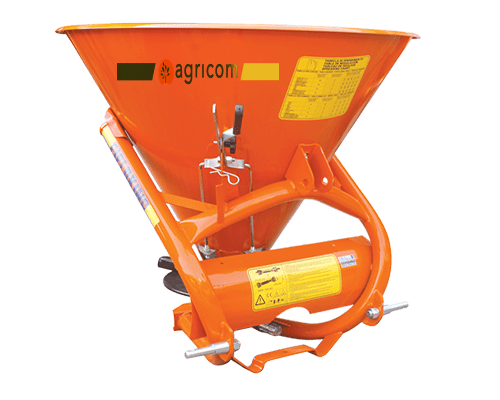
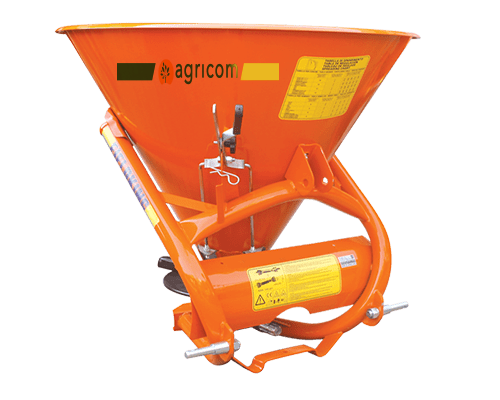
A fertilizer spreader is a piece of farm machinery used to distribute granular or pelletized fertilizer approved for the model across farms. It uses a hopper to hold the fertilizer and a spreading mechanism to distribute the granules across a set area. Uniform application is vital because it helps crops receive nutrients more consistently while reducing over-application, wastage, and areas with too little fertilizer. Manual spreaders are pushed or operated by hand and are suitable for small-scale farms. In contrast, tractor-mounted models may use the tractor’s PTO, hydraulic system, ground drive or another drive system, depending on the model, making larger-scale application more practical and less exhausting.
How does a fertilizer spreader work?
Operating a farm fertilizer spreader follows a simple sequence. This procedure ensures the fertilizer lands across the field and supplies the soil with nutrients required for crop growth. Here is the step-by-step procedure for operating a fertilizer spreader.
● The farmer begins by filling the hopper with the recommended amount of granular fertilizer.
● The application rate is adjusted according to the fertilizer type, crop, and required application rate.
● The spreader moves across the field at a steady speed to maintain consistent coverage.
● The farmer uses a metering system to control how much fertilizer leaves the hopper.
● Here, a spinning disc, agitator, or other spreading mechanism distributes the fertilizer across the soil.
● To avoid missed strips, the machinery operator follows straight or parallel passes with the recommended overlap.
Types of fertilizer spreaders
The most common types of spreaders include broad fertilizer spreaders, drop spreaders, and tow-behind spreaders. The table below shows the various types of fertilizer spreaders, how they work, and their application.
Type | How it works | Best for | Main benefit |
Tow-Behind Spreader | Attaches to a tractor or ATV and spreads fertilizer while being towed. | Large fields and open areas | Covers large areas efficiently |
Broadcast Spreader | Distributes fertilizer in a wide arc across the field. | Medium to large lawns and fields | Provides wide coverage |
Handheld Spreader | Manually distributes fertilizer through a small spreading mechanism. | Small gardens and tight spaces | Lightweight and affordable |
Drop Spreader | Drops fertilizer directly onto the soil below the spreader. | Narrow areas and precise applications | Reduces waste and overspreading |
Motorized Spreader | Uses a battery or engine to power the spreading mechanism. | Professional and large-scale operations | Saves time and effort |
3-Point Hitch Spreader | Mounts directly to a tractor for spreading fertilizer. | Agricultural fields | Handles large quantities efficiently |
Liquid Fertilizer Applicator | Applies or sprays liquid fertilizer across crops or soil. | Farms and greenhouses | Provides fast nutrient application |
Pneumatic Spreader | Uses air to distribute fertilizer through multiple outlets. | Precision agriculture | Provides accurate and even coverage |
Benefits of using a fertilizer spreader
Here are the important benefits of fertilizer spreaders for both large-scale and small-scale farming.
● They are precise and used to distribute fertilizers uniformly.
● Because of their accuracy, they help reduce fertilizer waste.
● Since they apply fertilizers quickly, they save time and help cover large fields.
● Compared to manual fertilizer application, using fertilizer spreaders helps farmers lower operational costs.
● When correctly selected and calibrated, spreaders can improve nutrient-use efficiency by applying fertilizer more evenly.
Read Also: Farm Tractors in Tanzania | Models, Prices & Buying Guide
Fertilizer spreader specifications to consider
To get the right fertilizer spreader machine for your farm, you need to consider a few key specifications. Some of the important things to check out for include:
Specification | What to consider |
Hopper Capacity | Choose a capacity that matches your farm size and fertilizer needs. |
Spreading Width | A wider spread covers more land in fewer passes. |
Application Rate | Check how accurately the spreader controls the amount of fertilizer applied. |
Spreader Type | Choose between broadcast, drop, pneumatic, liquid, or tractor-mounted models. |
Power Requirement | Check whether the spreader needs manual power, a battery, engine, or tractor PTO. |
Tractor Compatibility | For mounted models, check the required tractor horsepower and hitch category. |
Working Speed | Choose a spreader that can maintain consistent application at your normal operating speed. |
Fertilizer Compatibility | Make sure it can handle the type and size of fertilizer you intend to use. |
Construction Material | Durable materials help the spreader withstand regular farm use and fertilizer corrosion. |
Adjustment System | Look for simple controls that make it easy to adjust the application rate. |
Weight | Consider the spreader's weight, especially when using a tractor-mounted model. |
Maintenance | Choose a design that is easy to clean, inspect, lubricate, and repair. |
Read Also: Agricultural Machinery in Dar es Salaam: Modern Equipment for Smarter Farming.
Fertilizer spreader maintenance tips
These maintenance tips help ensure your fertilizer spreader works well. These points help ensure it lasts for a long time. Here are maintenance tips that farmers should know:
● Regularly inspect before use to check for wear and tear. Check for cracks in the hopper and blocked outlets, gates or spreading discs; inspect nozzles where a liquid fertilizer applicator is used.
● Focus on wheels and levers to apply grease to ensure smooth operation.
● Store properly in a dry, dust-free shelter.
● Replace damaged parts promptly to maintain the spreader's efficiency.
● Before using, check calibration regularly to ensure accuracy.
● After use, perform a thorough cleaning before storing.
Fertilizer spreader price in Tanzania
The prices for fertilizer spreaders depend on the type and size, brand/manufacturer, spreading width, whether it is tractor-mounted, new or used, construction material, calibration, and other features. Supplier services like warranties, spare parts, and after-sales support can also influence the overall cost.
Get up-to-date fertilizer spreader prices, models, and fertilizer spreader advice for your farm by contacting Agricom.
Why buy agricultural equipment from Agricom?
Agricom is a dependable supplier of fertilizer spreaders and other agricultural products for farmers in Tanzania. We offer farmers after-sales support, flexible financing, and a wide variety of products. Here are the key reasons why farmers choose Agricom:
● We have warranties on eligible farm equipment.
● Farmers in Tanzania can easily access our products and services through our multiple branches.
● We have financing options with partners including Stanbic and PASS.
● Our online store is available, and farmers can easily browse and inquire about agricultural equipment.
● We have a technical team to provide servicing and support to help ensure efficient operation of your equipment.
FAQs about fertilizer spreaders
What is a fertilizer spreader?
A fertilizer spreader is farm equipment used to distribute granular or pelletized fertilizer evenly across soil or crops. Liquid fertilizer is usually applied with a liquid fertilizer applicator or sprayer.
What are the different types of spreaders?
The various types of fertilizer spreaders include:
● Broadcast spreaders
● Drop spreaders
● Handheld spreaders
● Tow-behind spreaders
● 3-point hitch spreaders
● Pneumatic spreaders
● Motorized spreaders
● Liquid fertilizer spreaders
How much does a fertilizer spreader cost in Tanzania?
Prices vary depending on the brand, capacity, specifications, and supplier. Contact Agricom for current prices and available models.
What is the purpose of a spreader?
A fertilizer spreader distributes fertilizer evenly across a field at a controlled rate, helping crops receive nutrients consistently while reducing fertilizer waste, over-application, and missed areas.
Conclusion
Choosing the right fertilizer spreader depends on its compatibility with tractors, hopper capacity, spreading width, and fertilizer type. Choosing the right spreader can help minimise losses and save time in fertilizer application. Contact Agricom for current options, support and advice on suitable farm machinery and implements.
Visit Agricom’s online store today to find a fertilizer spreader that matches your tractor, farm size and application needs.